Sir Robert Yallop

The King is dead; long live the King!
Or are you?
According to local legend – yes. Writing nearly 40 years ago about ‘Bowthorpe: a Community’s Beginnings’, Ray Simpson, who went on to become the first Minister of the newly-built Worship Centre (now Bowthorpe Church) described how, following Sir Robert’s death in 1705, the stonemason employed to chisel an inscription on his tomb ran out of space and was forced to contract the word ‘Knight’ by leaving off the final two letters. “The remaining letters, slightly rearranged, form the word ‘King’ and ever since the locals have nicknamed him the ‘King of Bowthorpe’ ". And that was the caption Ray gave to an accompanying photo of the bust (above) [reprinted in the Bowthorpe Book 2017].
However, according to Norfolk Heritage Explorer – no. Summarising a survey carried out in 1976, it reports that the niche contains – of all things - a bust of a Roman Emperor! [www.heritage.norfolk.gov.uk]. Research is ongoing to get to the bottom of this conundrum but in the meantime I can dispose once and for all of the suggestion that a cack-handed stonemason was let loose to inscribe the tombstone of Bowthorpe’s most eminent denizen.
According to Francis Blomefield’s ‘History of the County of Norfolk’ (Volume 2, 1805), when he visited Bowthorpe in 1739 he found that Sir Robert had been buried in an altar tomb (today we would call it a chest tomb) in the churchyard with a memorial inscription in Latin, in which the word ‘Knight’ was rendered as ‘Militis’. So much for ‘Knig/King’ – a local legend in the fullest sense of the word (‘a story that has been passed down for generations, especially one that is presented as history but is unlikely to be true’ - Encarta Dictionary).
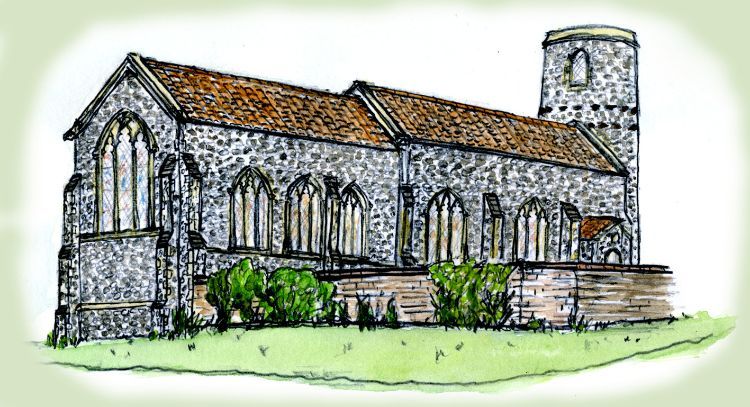
Sadly his tomb in the churchyard, together with that in the ruined church of his widow, Lady Dorothy, and four of their five children who died in infancy, has disappeared, destroyed presumably when the new church was added on to side of the old one in the late nineteen-seventies. Certainly they were still largely intact during the early seventies, as attested by Sue Cant, a descendent of the Yallop family, who told me recently, “When I was a teenager and living in Norfolk, I visited Bowthorpe a few times. In those days there were only green fields – no multitudes of houses! I recall seeing Robert and Dorothy’s tombs as well as a few others for the Yallop family. I revisited a few years’ ago and there was no sign of any of them.”
However, Mike Dack, another Yallop descendent and administrator of the Norfolk Online Record Search (NORS) database, maintains that as recently as 2009 three broken parts of Lady Dorothy’s black marble tomb were visible outside the ruins of the old church. Again, researching is continuing.
The simplest way to resolve the dilemma of course is to seek out an illustration of Sir Robert. Unfortunately none appear to exist. An online examination of illustrations of the emperors who reigned between 27 BC and the dissolution of the Roman empire in 565 AD [www.romanemperors.com] – all 66 of them – fails to yield one who resembles the Bowthorpe Hall sculpture. So I put the question to Mike Dack. In reply he sent me a copy of a portrait of Sir John Harrison Yallop (1762-1835), twice both Sheriff and Mayor of Norwich, who was Sir Robert’s first cousin, four times removed, pointing out that both the Bowthorpe bust and Sir John have a distinctive feature – a prominent proboscis also known as the Yallop nose – rather a Roman nose, in fact, which might explain the confusion over identity.
For me, that chinches it. Even without the distinct resemblance between the two men, I would suggest that the noses have it and that the Bowthorpe bust is definitely of Sir Robert. How old it is, and indeed whether or not it is original, is difficult to prove; it has definitely been in situ since 1860 as a photograph of the front of the Hall was taken in that year showing the Bacon Frank family playing croquet on the lawn with the bust of Sir Robert looking benevolently down at them [Picture Norfolk online catalogue].
How Sir Robert – who was very much a Norwich man, having been born in Thorpe – came to settle in Bowthorpe for most of his life is well recorded. A barrister by profession, having been admitted to Gray’s Inn London (one of the four professional associations for barristers and judges) in 1653, he was able to come to the assistance of Henry Yaxley, the original owner of Bowthorpe Hall. Yaxley was a practising Roman Catholic and therefore, according to the law of the day, a recusant - meaning someone who refused to attend services of the Church of England and thereby committed a statutory offence under the Elizabethan Recusancy Laws.
One of the ways recusants got round the law was to transfer their estates to relatives who were loyal to the English crown, with an unwritten agreement that the estates would revert to them in due course. Yaxley made over Bowthorpe Hall, and at least one of his estates in Yorkshire, to local relatives, the Browns of Colney, and removed himself and his family to Yaxley Hall in Suffolk. Unfortunately for him, the head of the Brown family tried to renege on the deal and keep the estates for himself. Retained by Yaxley, Sir Robert used his legal expertise, and no doubt his range of influential contacts (his father-in-law was a senior judge in London) to get the estates back, for which Yaxley rewarded him by gifting the estate of Bowthorpe.
However, it is important to note that Sir Robert himself was never a recusant. He was a Protestant, a regular worshipper at, and benefactor of, Bowthorpe Church, and loyal to the English crown. Indeed, it was his fierce loyalty to the Royal Stuart dynasty that brought calumny and disaster upon his head when, in 1688, Parliament challenged the divine right of Kings to rule as they wished by instigating the so-called Glorious Revolution.
Having established that the life-sized bust in the niche above the front door of Bowthorpe Hall does indeed represent the “King of Bowthorpe”, Sir Robert Yallop, who occupied and rebuilt the hall in 1660, it is logical now to explore his life as squire, patron and benefactor of the village. There is, however, a problem; in the same way that portraits or even drawings of Sir Robert appear not to exist, so his life is particularly difficult to research for lack of biographical information. Here is what we do know.
He was born in Thorpe-next-Norwich on 21st October 1637, the third son of Robert (described as a gentleman) and Joan Yallop, nee Giles. His father was obviously a wealthy man as Robert junior was educated at Wadham College, Oxford, following which, in 1653, Robert senior purchased a place for him at Gray’s Inn London, one of the four professional associations for barristers and judges. Here Robert trained to become a barrister, a career which he pursued – mostly in Norwich – for the rest of his life.
It was while he was at Gray’s Inn that he met and fell in love with Dorothy Spelman, the 22-year-old eldest daughter of Clement and Mary Spelman (nee Mason) and the pair were married on 21st July 1657 at St Gregory’s by St Pauls’, a parish church in the Castle Baynard ward of the City of London. For Robert it was a ‘good marriage’ both personally (by all accounts the couple were devoted to each other) and professionally, as Dorothy’s father was a Baron of the Exchequer – a senior lawyer sitting as a judge in a court of common law with the title Mr Baron Spelman. There were also professional and personal connections – both were members of Gray’s Inn and fellow Norfolk men, as Clement hailed from Sedgefield.
Despite such auspicious beginnings, cemented by Robert being knighted by King Charles II in the Palace of Whitehall on 29th June 1664 at the early age of 27, life was hardly a bed of roses for him and Dorothy. As was so often the case in those days, they started a family quickly after their marriage and had three young children by the time they moved into Bowthorpe Hall in 1660. Sadly, within the next decade, all three had died and been buried in the chancel of Bowthorpe Church. Their ledger-stone read as follows: ‘Here lyeth the Bodyes of Robert, Henry and Dorothy Yallop, Children of Sir Robert Yallop of Bowethorp Knight, and Dorothy his Wife, which children were born and died in their infancy, between the Years of our Lord, 1660 and 1670.’ Only one child, Charles, lived to adulthood.
Nor was Sir Robert’s life free from further heartache, controversy and brushes with the law. No sooner were the family installed in Bowthorpe Hall than he was hauled before the House of Commons for an alleged breach of parliamentary privilege. The journal of the proceedings of the House of Commons dated 30th August 1660 tells us that Nicholas Shephard, Clerk (a legal title for an Anglican clergyman) and Chaplain to the Speaker, had been arrested and detained by Robert Browne and Charles Brooke, “at the suit of Robert Yallop”. The House “ordered that the Serjeant at Arms […] do send for the said Robert Yallop, Robert Browne and Charles Brooke, in custody, to answer their Contempt and Breach of the Privilege of this House” [Source: British History Online].
Untangling this cryptic minute, it appears that Robert Yallop was retained as lawyer for Browne and Brooke to bring a lawsuit against Shephard, probably for debt, either on their own behalf or for somebody else. Possibly Shepard was then detained in one of London’s debtors’ prisons (perhaps the Fleet or Marshalsea), despite his pleas to his captors that he was protected by parliamentary privilege. In England, at that time, around 10,000 people were imprisoned for debt each year [Source: Wikipedia, Debtors’ prison].
After that – nothing. There was no further mention of the matter in the records of the proceedings of the House for the remainder of the parliamentary term. The only clue to a possible outcome came on 11th September 1660 when the minutes recorded that a list of prisoners remaining under the charge of the Serjeant at Arms was read and they were discharged, “paying their fees”. The names Yallop, Browne and Brooke were not among them.
I suggest it is fair to deduce from this that the lawsuit against Shepard was proved to the satisfaction of the Serjeant at Arms and Browne and Brooke, together with Robert Yallop, were quietly discharged from custody. A further clue can be found in the House proceedings dated 6th September when the name of Edward Voyce MA was forwarded to the King for approval as the new Chaplain. Shepard, presumably, was in disgrace, deprived of his position – and still in prison.
Another 35 years elapsed before the name of Sir Robert Yallop appeared again in the parliamentary record, during which time the relationship between the monarchy and Parliament had changed dramatically. Charles II had died in 1685, succeeded by his brother, James II. The new king, a Catholic, reigned for only three years before he was deposed by Parliament in favour of his Protestant daughter Mary and her Dutch husband, William of Orange. This event – the so-called Glorious Revolution - ultimately changed how England was governed, giving Parliament more power over the monarchy and planting seeds for the beginnings of a political democracy. For Sir Robert Yallop, however, it spelled divided loyalties and the prospect of financial ruin.
Robert’s knighthood in 1664 probably resulted from services rendered to the royalist cause and he evidently became sufficiently attached to the existing royal order to resent deeply any attempt to interfere with it. He embraced Jacobitism, a movement that argued that monarchs were appointed by God and could not be removed. Worse still, from the establishment viewpoint, he became a non-juror – that is, somebody who refused to take the Oath of Allegiance to the new monarchs (he was in good company: another non-juror was William Lloyd, Bishop of Norwich). And even worse than that, there was a suspicion that he may have become involved in one of the many Jacobite plots to restore what they regarded as the rightful monarchy by violence – possibly an unsuccessful attempt in 1696 to ambush and kill William of Orange as he returned from a hunting trip.
The public record to support the above remains tantalisingly brief. Mike Dack, suggests that “Sir Robert was a supporter of the Stuart cause and had become persona non grata after being involved in a conspiracy to reinstate them. He may even have spent some time in prison and certainly lost all the Bowthorpe estates.”
Mike has also unearthed a report from the Norwich Assizes of 24th April 1696 recording that Sir Robert Yallup [sic], Sir Christopher Calthrop (a non-juror and former MP for Norfolk) and Sir Nicholas Lestrange (another non-juror and MP for Castle Rising) “upon summons appeared at the sessions and had the oaths tendered to them and all refused: the latter (Lestrange) paid his £5 and found security according to law, but the other two refused to take the oath or pay the fine and so are committed (presumably to prison).” In an extraordinary outburst, the report concluded, “Sir Robert Yallup is the greatest knave in nature, but the other two very honest gentlemen” (!) And so Sir Robert paid for his loyalty by forfeiting Bowthorpe Hall and its estates and suffering a spell of imprisonment within the walls of Norwich Castle gaol.
So Sir Robert, and his wife Lady Dorothy, were forced to find somewhere to live. As luck would have it, their only surviving child, Charles Yallop, had married an heiress, Helen Barkham, only daughter of Sir Edward Barkham of South Acre in the west of the county; Sir Edward had been Sheriff of Norfolk in 1671. The fact that Sir Robert (in 1705) and Lady Dorothy (14 years later) both died at South Acre Hall indicates that this was where they spent their remaining years. However, despite this enforced exile, it is plain that Bowthorpe continued to exert a powerful influence on them, for both were determined to return to lie at rest within the boundaries of Bowthorpe Church, within a few yards of the Hall where they had spent so much of their married lives.
The first body to be coffined and conveyed across the county was that of Sir Robert. From the Latin inscription on the chest tomb in which he was buried in the churchyard it appears that he may have taken a close interest in its construction; according to Robert Noel, Lancaster Herald at the College of Arms, who is an expert in translating and interpreting ancient Latin texts, the King of Bowthorpe not only wrote the inscription but appears to have commissioned and supervised the building of the tomb, implying at least one return visit to Bowthorpe during his lifetime.
Lady Dorothy’s remains followed the same route in January 1719, to be buried not in the churchyard but within the chancel, presumably because this was the resting place of her three young children. This time the inscription on her ledger tomb was in English, describing her as “a Lady no less Adorned with the Endowments of Nature than of Virtue, and as the Former gave her the esteem of Men, so the latter qualified her for Heaven, for if the Merciful shall obtain Mercy, she in whom Compassion, and Charity to the distressed, shined so bright, may justly be presumed to have met with a like Return from the Father of Mercies.” She died at the age of 84.
So – apart from the bust of Sir Robert above the main door of Bowthorpe Hall -- what tangible reminders are there of the King of Bowthorpe and his lady? A visit to the treasury of Norwich Cathedral is rewarding in this respect, for in the east display case, exhibits 44 and 45, are an inscribed alms dish and communion cup with cover, both dated 1680, which were gifted to Bowthorpe Church by Sir Robert and Lady Dorothy. These were made by Arthur Haselwood II (1638-1684), one of four members of the same Norwich family, all of whom were goldsmiths, at his workshop in Little London Street.
As to what remains of the Yallop family resting places, and indeed of the family themselves, there are fragments of Sir Robert’s chest tomb in the north-west corner of the ruined chancel, while several pieces of Lady Dorothy’s ledger stone adorn the outer side of the south wall of the ruined church.
When Norfolk archaeologists excavated the ruins prior to the new church centre being built in the mid-nineties, it might have been expected that remains of the Yallop family would have been discovered, but in the event this was not so. The remains of two adult males and two children were recovered; however, both children were judged to have been buried in medieval times i.e. prior to the 17th/18th centuries, and therefore couldn’t have been Yallop children, who we know were buried in the chancel between 1660 and 1670.
As for the men – one was found buried in an 18th century brick oven that had been established at the base of the church tower to dry corn. Whatever was he doing there? Sounds like an ancient murder mystery worthy of the attention of Brother Cadfael or Matthew Shardlake …
Mike Gibbs
October 2020